
Intent
At Western Primary School our English curriculum is designed to develop children’s love of reading, writing and discussion and prepare our learners for life as successful, valuable and socially responsible citizens. We inspire a reading for pleasure culture and a habit of reading widely and often. We nurture a culture where children take pride in their writing, can write clearly, imaginatively and accurately and adapt their language and style for a range of contexts. We inspire children to be confident in the art of speaking and listening and to use discussion to communicate and further their learning in all areas of the curriculum.
We believe that children need to develop a secure knowledgebase in English, which follows a clear pathway of progression as they advance through the primary curriculum. Our carefully sequenced, broad and balanced curriculum, underpinned by inclusive practice, aims to provide our children with the opportunity to build on their experiences in order to achieve their goals. We believe that a secure basis in English skills is crucial to a high-quality education across the curriculum. We whole-heartedly ‘promote high standards of English by equipping pupils with a strong command of the spoken and written word, and to develop their love of literature through widespread reading for enjoyment.' (National Curriculum 2014)
Implementation
Our English curriculum is implemented through the use of rich texts and engaging pupils with a cross-curricular approach and visual literacy. Texts are chosen to link with the topics pupils are learning about and these are used as a springboard to inspire pupils to read and write. We believe that choosing the right context and starting point to engage our children in their learning is vital in fostering a love for reading and writing.
Our English curriculum aims to provide many purposeful opportunities for reading, writing and discussion. We want all of our pupils to be proficient readers, writers, spellers and speakers, who can transfer their English skills to other curriculum subjects and who are prepared for the next steps in their education. Our English lessons develop pupils’ spoken language, reading, writing, grammar and vocabulary, teaching them how to write within specific genres and which structural and language features to include to be successful. Example texts are used to start this process to enable pupils to use other similar writing as models for their own. Lessons also focus on teaching specific spelling, grammar and punctuation skills to enable our pupils to apply the skills they have been taught to their extended writing and writing across the curriculum. We teach our pupils to speak clearly, to convey their ideas fluently and confidently and to ask questions. Teachers use a wide variety of resources as appropriate to their classes.

Reading
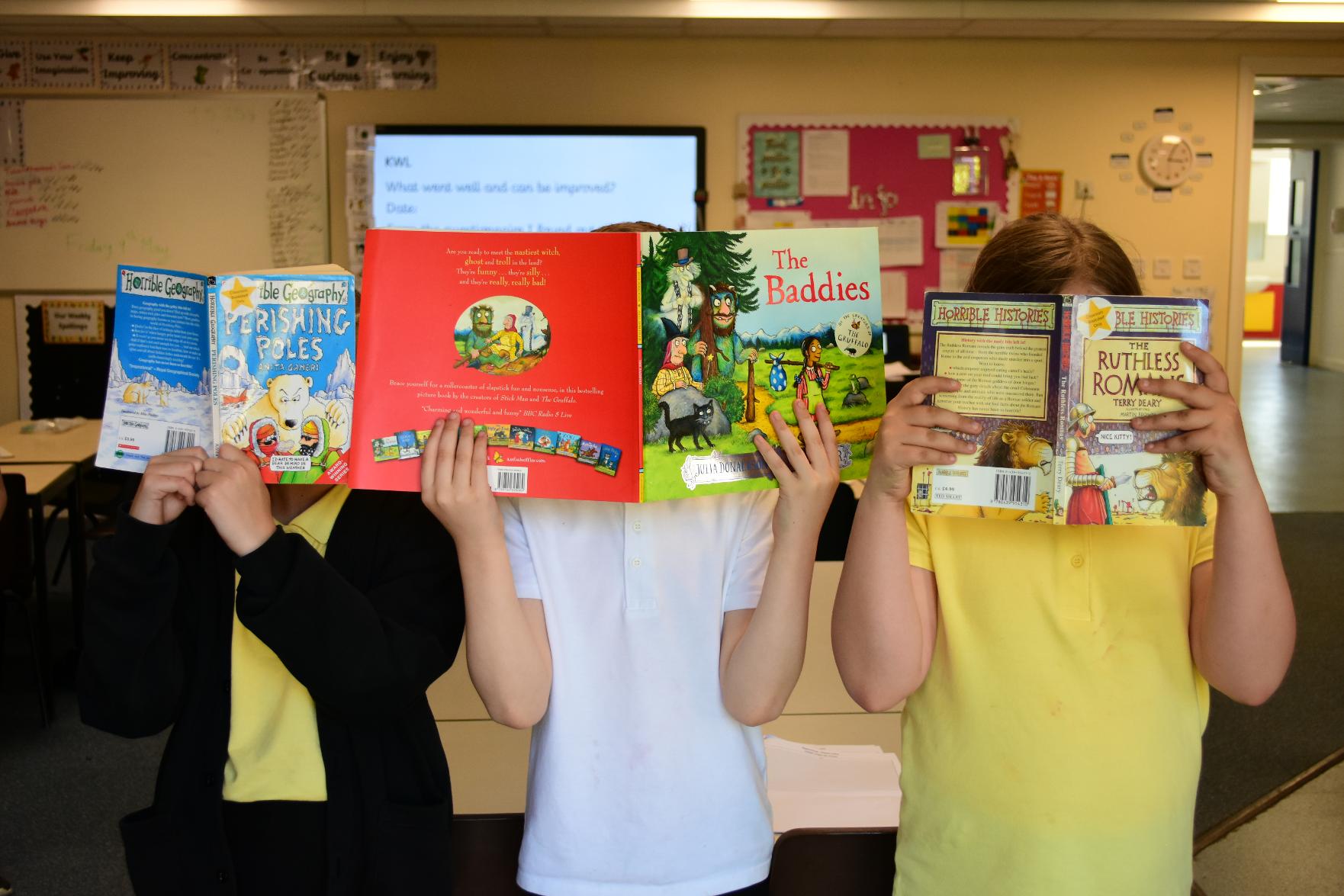
Quality children's literature is at the heart of our pupils’ learning. In Key Stage 1 we have a well-developed reading spine to promote high level vocabulary and reading for pleasure.
Throughout Key Stage 1 and 2 we teach English through the use of high-quality picture books, novels, poetry and non-fiction engaging pupils using a wide range of teaching approaches. Children are immersed into the text through music, art, drama, discussion and role-play.
Our pupils are encouraged to read for pleasure and to read widely through our reading scheme and frequent use of the school library. Pupils at Western Primary School continue to develop a range of reading skills, as well as a love of reading through daily reading sessions. These daily reading lessons consist of sessions reading and answering VIPER questions about a class text, poetry/non – fiction comprehension, reading for pleasure and fluency/independent comprehension.
Pupils read books at their own reading and interest levels, enabling a greater sense of enjoyment and success. Best of all, they learn and grow at their own pace. Our guided reading sessions cover a wide variety of both fiction and non-fiction books and help to advance the children’s comprehension skills.
We also provide enrichment opportunities, such as participating in Book Week, celebrating World Book Day, national poetry day and national story - telling day. These additional experiences help us to enrich the curriculum even further and continue to deepen the children’s learning. Our children also benefit from a reading shed which can be accessed at playtimes and dinnertimes as well as a well-stocked school library which children visit on a fortnightly basis. We also hold regular reading assemblies where staff share their favourite stories with the whole school to promote a love of reading.


Writing
All children from Reception to Year 6 are provided with many opportunities to develop and apply their writing skills across the curriculum. Initially, pupils need to be able to form the letters needed and then be able to express one’s ideas using these letters. Through shared and guided writing opportunities, we equip children to develop the skills of writing clearly and legibly. When the child is confident with these basic skills, they work towards being able to write with a greater sense of purpose and learn to organize their writing according to this purpose. Children are equipped with the necessary tools to do this, being given daily opportunities to focus on spelling and/or grammatical structures.
We develop our pupils’ writing skills so that they have the stamina and ability to write at length, applying the skills set out in the English National Curriculum.
To support children in moving towards independent writing we provide a wide range of activities including the use of film and imagery, ICT, modelled, shared and guided writing, peer assessment and discussion. We provide varied and exciting opportunities for writing for purpose, and we encourage pupils to see themselves as authors and poets. We promote the importance of written work by providing a writing purpose and opportunities for children’s writing to be read aloud and listened to by an audience. We also promote writing for cross curricular purposes.
We use the following Grammarsaurus writing units to teach English:

|
Grammarsaurus Writing Overview | [pdf 922KB] |

|
Spelling, Grammar and Punctuation:
At Western Primary School, we aim for our pupils to become fluent and effective writers. Accurate use of spelling, punctuation and grammar is essential to this. We use the National Curriculum 2014 as a basis for teaching Spelling, Punctuation and Grammar by introducing patterns or conventions and continually practising those already introduced.
Punctuation and Grammar is taught within the context of each text studied in English. Pupils are taught key rules and strategies with opportunities to analyse how other writers have applied these skills to model texts and extracts in order for our pupils to apply these skills independently and effectively to their own writing. Pupils are taught to recognise which strategies they can use to improve their own spelling. They are encouraged to apply learnt strategies to their independent writing.
In Reception and Year 1, children learn spelling largely through their daily phonic sessions. From Year 2 onwards, we use daily Active Spelling lessons. The teaching and learning of grammar and punctuation is embedded within the English teaching sequence. This means, grammar and punctuation skills and knowledge are built into a sequence of preparatory work which is then applied within longer pieces of writing during the teaching sequence. As they become more confident, children are encouraged to check spellings using a dictionary and to expand their vocabulary using a thesaurus.
|
|
Grammarsaurus Grammar Overview | [pdf 180KB] |
|
Impact
At Western Primary School, our English curriculum is designed to develop confident, articulate, and thoughtful communicators who read and write with purpose and understanding. The impact of our approach is reflected in pupils’ ability to speak clearly, listen actively, read fluently, and write effectively across a range of genres. Through a consistent, progressive curriculum and high-quality teaching, children develop a deep appreciation of language and literature, enabling them to access learning across the wider curriculum. By the end of Key Stage 2, our pupils are well-prepared for the next stage of their education, with the skills, knowledge, and enthusiasm needed to become lifelong readers and capable writers. Regular assessment and monitoring ensure that our English provision continues to meet the needs of all learners, including those with additional needs or who speak English as an additional language.